

This timeline highlights Revolutionary-era events as experienced by members of the Cabell family. It is not intended to be comprehensive; it reflects the surviving letters, diaries, and other writings currently available. As a result, coverage is fuller for some individuals—such as William Cabell Sr.—than for others whose personal records have not survived.
Place names and county references follow Virginia’s county boundaries as they existed from 1774 to 1788. Mentions of Amherst County during this period may include areas that are now part of present-day Nelson County, Virginia.
1773
December 16
The Tea Party That Started a Revolution

- Angry colonists dress as Native Americans and dump 342 chests of British tea into Boston Harbor to protest unfair taxes. It’s one of the boldest acts of rebellion against King George III.
- A furious British Parliament punishes Boston by closing the harbor and taking away Massachusetts’ right to govern itself. The harsh punishment is called the Coercive Acts—but colonists call them the “Intolerable Acts” because they refuse to tolerate being treated this way.
- The punishment of Boston shocks Virginia and the other colonies. If Britain can do this to Massachusetts, they can do it anywhere. Colonial leaders realize they must stand together and prepare to fight for their rights—or lose their freedom forever.

1774
April 12
Dr. William Cabell Leaves a Legacy (12 April 1774)
- Dr. William Cabell dies at Liberty Hall in Warminster, Virginia, leaving 28 living descendants living in five plantations along both sides of the James River (Cabell homes). When the Revolution comes, all four of his sons and seven grandsons answer the call for American independence.
- Sons William, Joseph, John, and Nicholas join the Patriot cause, alongside grandsons William Jr., Robert, John Horsley, Samuel Jordan, Landon, and Joseph Jr.—a family united in the fight for freedom.

May 1
Growing Colonial Unity (May 1774 – Sep 1774)
-
- Williamsburg, VA: Members of the Virginia House of Burgesses including William and Joseph Cabell adopt resolutions supporting Boston; in response, Lord Dunmore dissolves the Virginia Assembly. However, by July, William and Joseph are unanimously elected as Representatives from Amherst County in a shadow government.
- In August, the representatives hold the First Virginia Convention where they adopt the Virginia Association to prohibit the import of merchandise from Great Britain hoping to persuade Parliament to repeal the measures. The members also appoint seven delegates to represent Virginia in the First Continental Congress that would meet in September.

- Fall 1774: The First Continental Congress meets in Philadelphia and unites colonial leaders in organized resistance to Britain.
1775
March 9
Revolutionary Awakening (Mar 1775 – Apr 1775)
- March 9, 1775: The Virginia Gazette reports on the Massachusetts Provincial Congress, warning that peaceful appeals are failing and urging Virginians to prepare for possible military action.
- Richmond, VA: Delegates William and Joseph Cabell attend the Second Virginia Convention, where Patrick Henry urges organizing the militia and placing the colony in a state of defense; after intense debate, the proposal passes and Virginia begins preparing for war.

- After the Convention, Governor Lord Dunmore grows alarmed by rising unrest following the First Continental Congress and increasing militia activity.
- Fearing the public gun powder magazine in Williamsburg could be used against British authority, Lord Dunmore secretly orders the gun powder removed to a British ship, a move that angers colonists and further fuels resistance across Virginia.

May 9
Williamsburg Standoff (May 1775)
-
- Upon hearing that Dunmore has moved the gun powder, a volunteer militia from Amherst County, led by Capt. James Higginbotham, Lt. Joseph Cabell, and Ensign Nicholas Cabell gather at Nicholas Cabell’s home, Liberty Hall, and begin their march to Williamsburg to recover it. They join Patrick Henry and march to Williamsburg together.

- Just outside of Williamsburg, rather than attacking, Henry demands compensation for the gunpowder removed by Lord Dunmore.
- Royal officials pay for the gunpowder, and the militia peacefully goes home. Virginia proves it will stand up to British authority—even if it means taking up arms.
November 1
Amherst Militia Mobilizes & Joins the War (July 1775 – Jan 1776)
- In Amherst County, two minutemen militias are formed—one under Capt. Nicholas Cabell and 3rd Lt. Robert Horsley, and another under Capt. Gabriel Penn; their flag reads “Virginia for Constitutional Liberty” and “Buckingham District,” with daily pay set by rank.
- In Rockfish Gap, VA, Capt. Nicholas Cabell and Capt. Gabriel Penn lead their militias to train with other local units near Afton Mountain, and after two weeks they began their march to Williamsburg.

1776
March 1
The Amherst Company of the Sixth Virginia Regiment
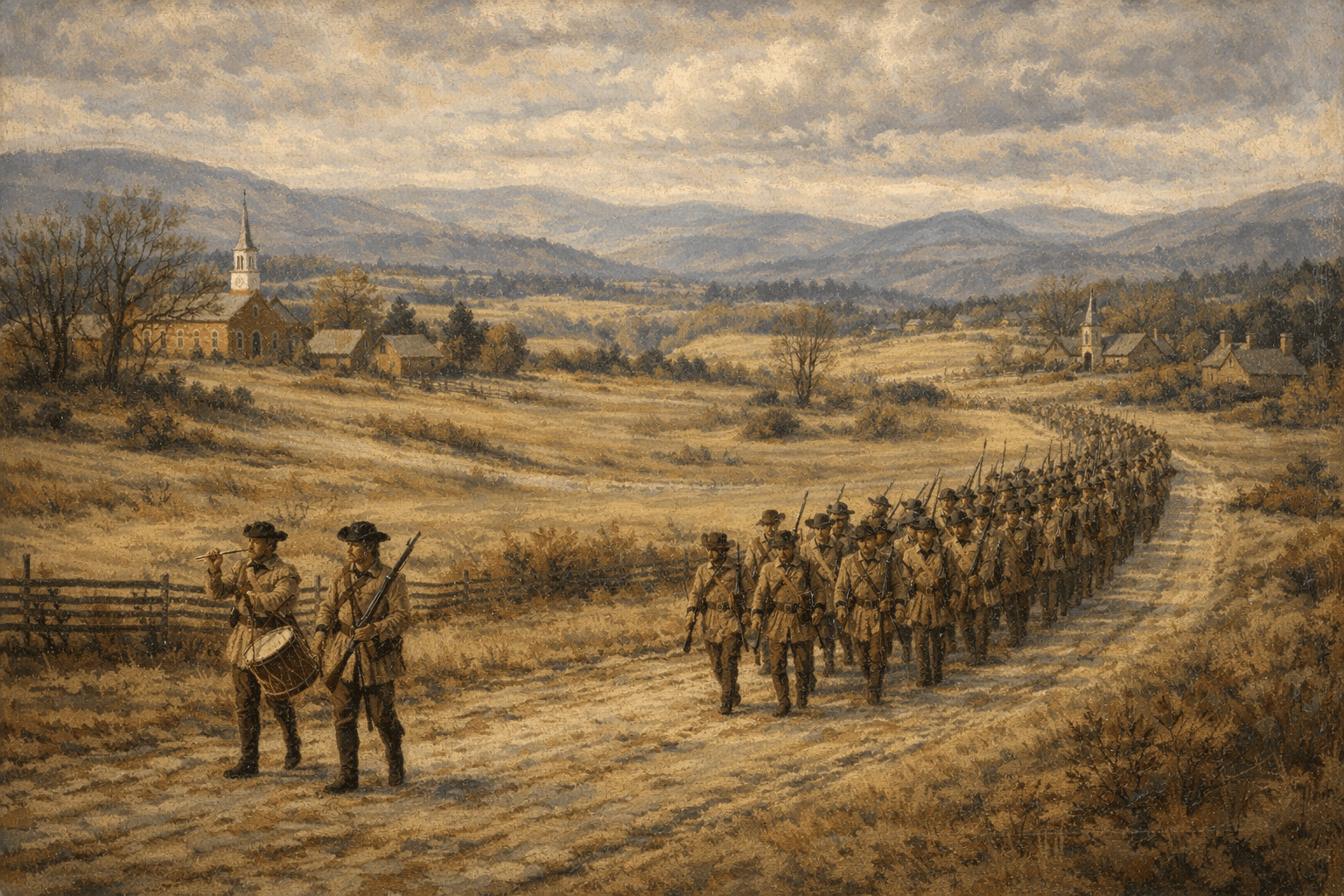
- In March 1776, the Amherst Company is officially established with Captain Samuel Jordan Cabell and his officers commissioned into the 6th Virginia Regiment of the Continental Army. His officers include Alexander Rose as 1st Lieutenant, Benjamin Taliaferro as 2nd Lieutenant, and James Barnett as Ensign.
- Captain Cabell conducts four months of intensive training for his Amherst riflemen before leading them on a ten-day march to Williamsburg.
- William Cabell reimburses Samuel Cabell for 30 gallons of whisky obtained during the march to Williamsburg.
- Read more about Samuel Cabell’s Company of Sharpshooters.
May 5
Independence Declared
- Williamsburg, VA: William and John Cabell attend the Fifth Virginia Convention, meeting in the House of Burgesses Chamber.
- John Cabell is appointed to the Virginia Committee of Correspondence, which coordinates Virginia’s grievances and communications in response to British actions.
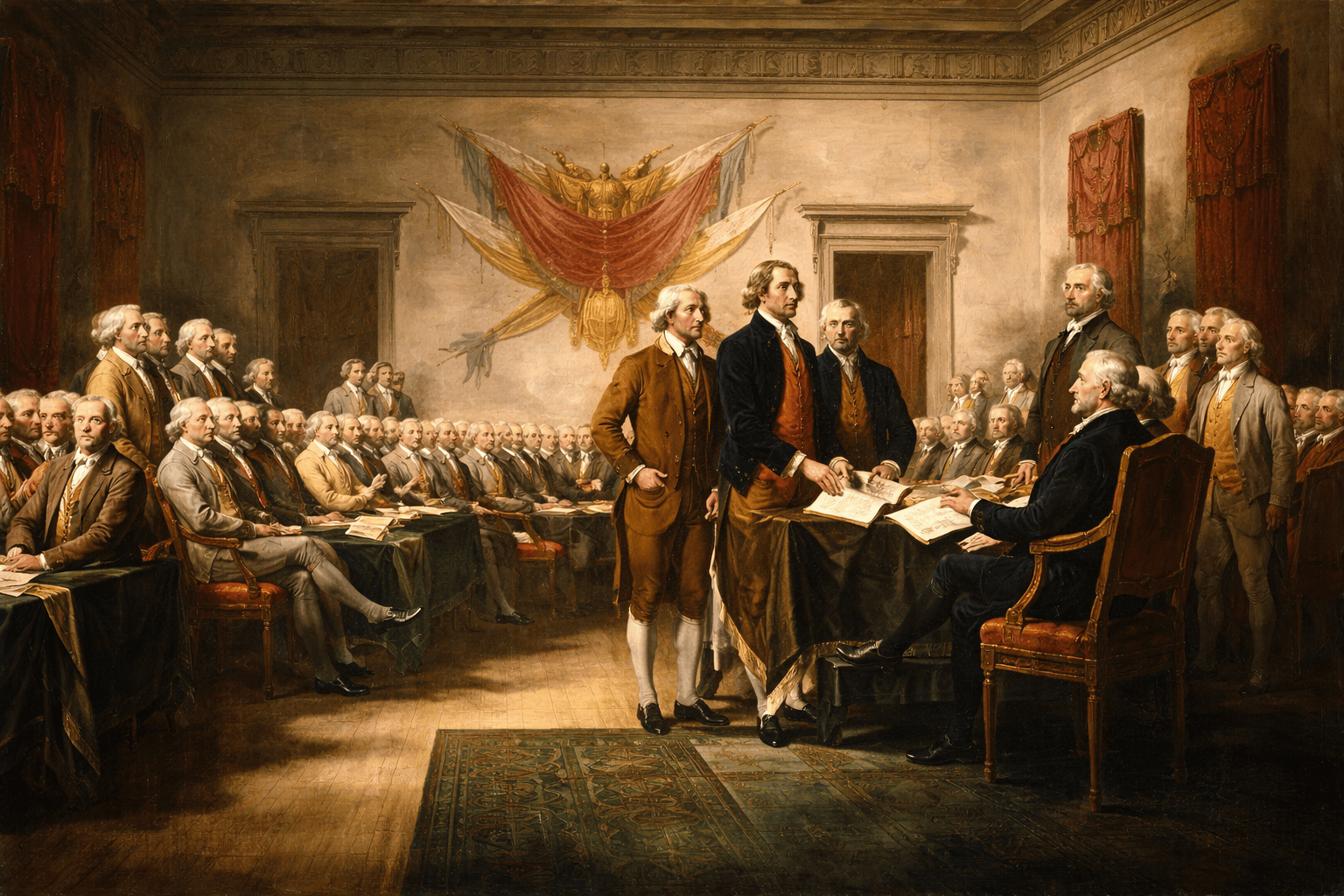
- Later in the session, the Convention unanimously adopts a resolution instructing their delegates to the Continental Congress to introduce a motion declaring the colonies “free and independent states.”
- They also adopt the Virginia Declaration of Rights, the state’s first written constitution, and elect Patrick Henry as the first Governor.
September 20
Joining Washington’s Army
-
- In September 1776, Captain Samuel Jordan Cabell and the 6th Virginia Regiment march over 400 miles north through Fredericksburg, Maryland, and Pennsylvania to join General Washington’s main army. On September 3, 1776, the regiment is officially transferred to General Adam Stephen’s Brigade.
- Samuel and his riflemen arrive when Washington desperately needs them. After crushing defeats at Long Island, Manhattan, and Fort Washington, the Continental Army is retreating through New Jersey. By November 25, Samuel’s company is in Newark with 30 men fit for duty, joining Washington’s “Retreat to Victory” that will lead to the crossing of the Delaware River in December.
- Read the story here.

October 1
Life on the Homefront in 1776
- Our understanding of the Cabell family’s Revolutionary War homefront is drawn largely from the preserved journals of William Cabell Sr.—the day-to-day record of one man whose careful notes offer a rare window into how wartime pressures shaped ordinary family life.
- In these journals, the Revolution’s homefront is not heroic scenery; it is families coping with absence, shortage, unstable money, and the unending work of keeping life going.
October 7
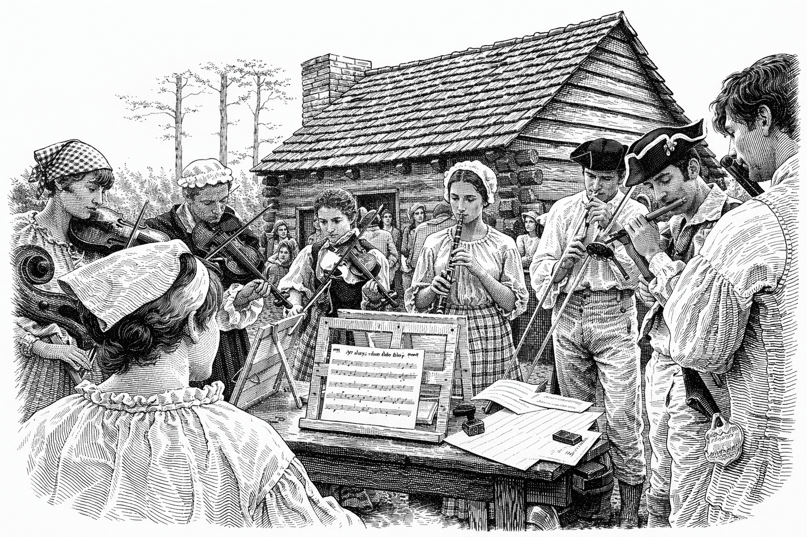
First Virginia Assembly


1777
August 1
Saratoga Campaigns

- Saratoga, NY: Captain Daniel Morgan’s Riflemen including Samuel Jordan Cabell are sent to Major Horatio Gates forces near Stillwater and battle for victory over the British at the Battles of Saratoga on October 7.
- Morgan’s Riflemen play a key role in the Second Battle of Saratoga in which they stopped General Burgoyne’s advance leading to his surrender on October 17.
- This secures a turning point that brings French support to the American cause.
- Saratoga Campaign (Coming Soon)
November 1
Recruitment Crisis
- December 19, 1777 –During the winter of 1777, Alexander Rose, Ben Taliaferro, and Sam Cabell all return home to recruit new soldiers. William Cabell paid them for recruiting services.
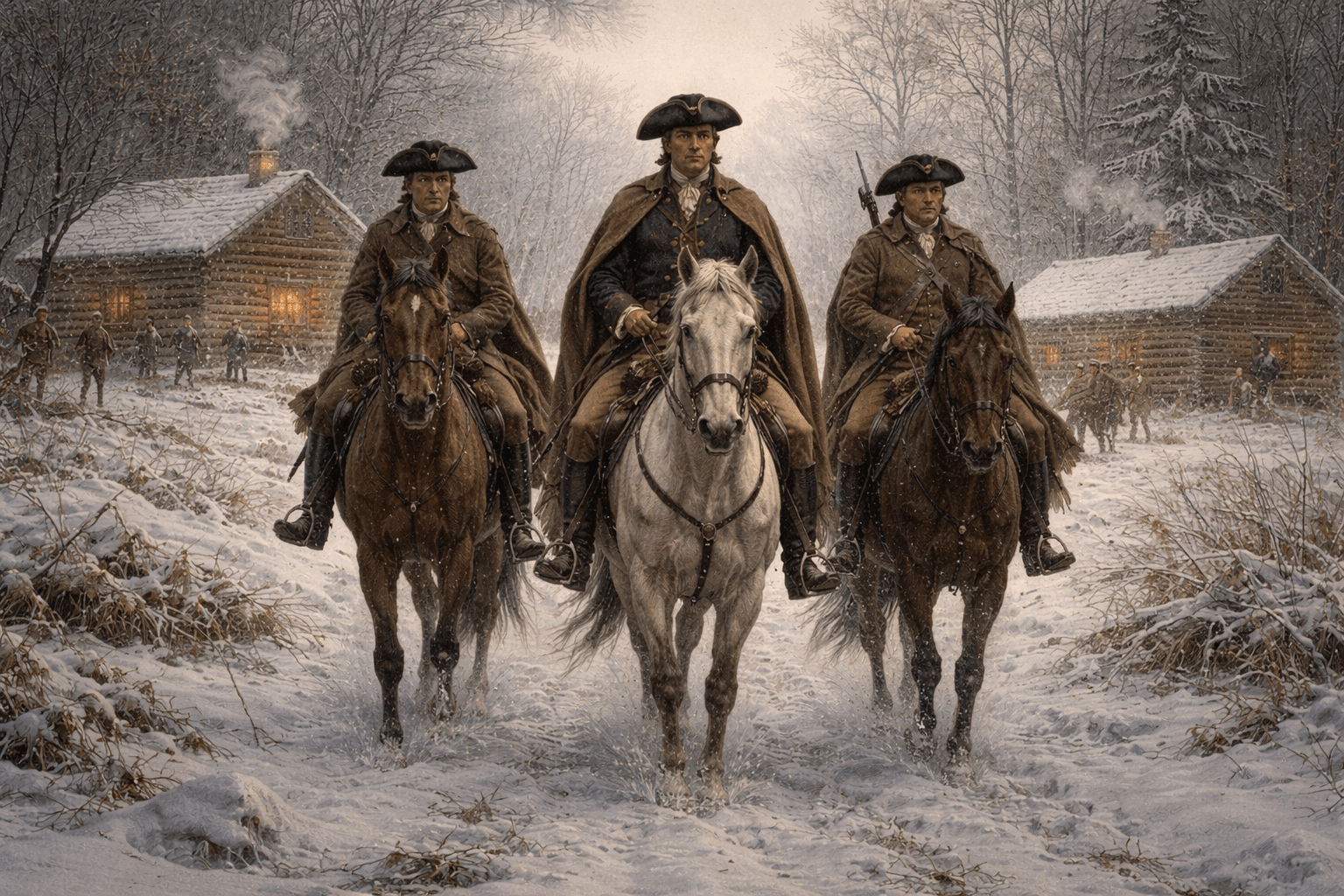
- Spring 1778 – Amherst County, VA: As two-year enlistments expire, some Continental soldiers reenlist while most return home to continue militia service.
- April 21, 1778 – Valley Forge: General George Washington reports to the President of the Continental Congress that resignations are surging, noting that the Virginia Line has suffered heavily, with at least ninety officers already resigning.
1778
June 19
Battle tested
- After leaving winter quarters at Valley Forge, George Washington’s army attacks British forces retreating across New Jersey.

- Although indecisive, the engagement forces the British to continue retreating and boosts American confidence.
December 15
Rebuilding and Raiding (1778-1779)
-
- In December, Samuel Jordan Cabell is commissioned as a Lt. Colonel.
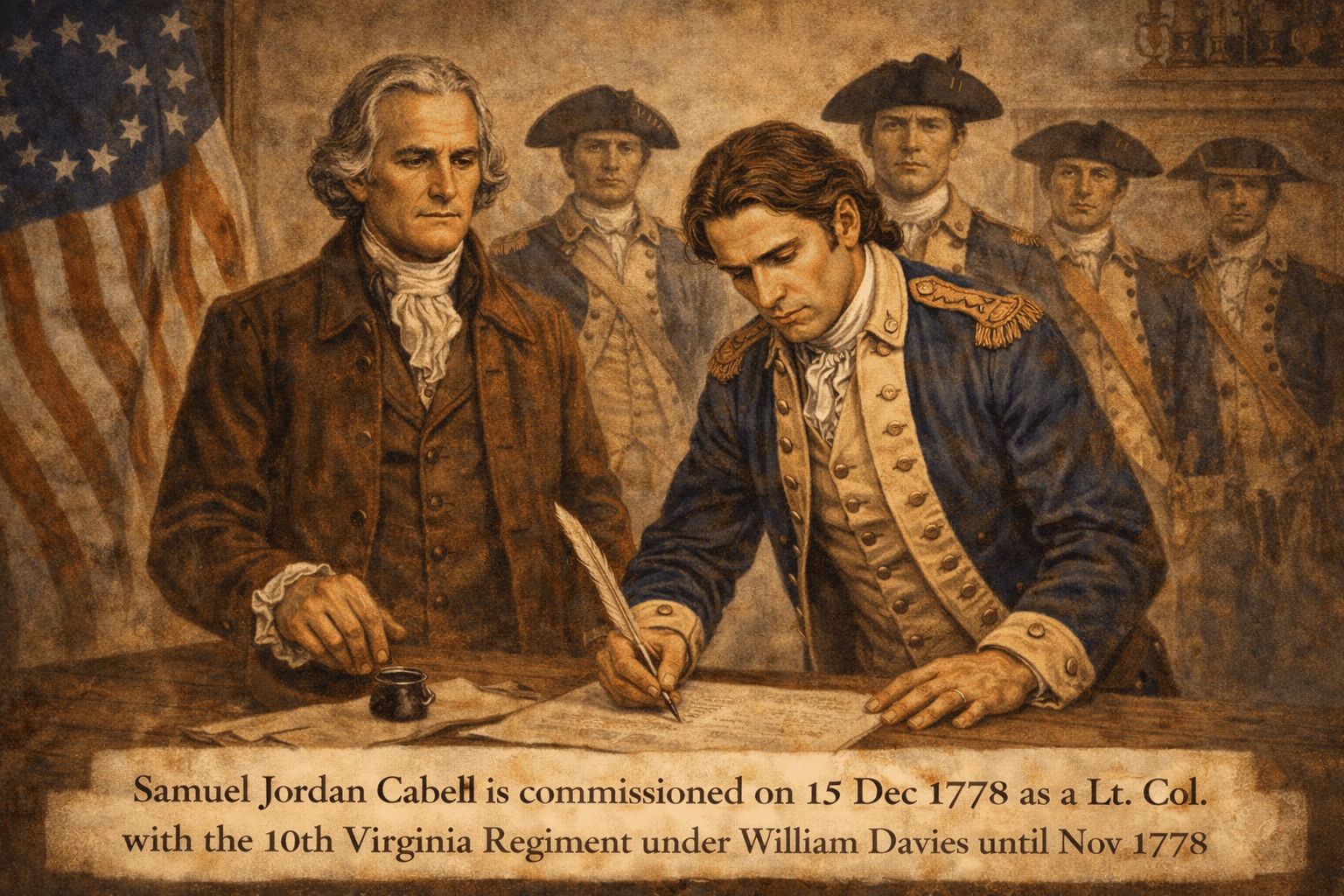
- The Continental Army spends the winter in the Middlebrook area of New Jersey, recovering from the 1778 campaign. Washington’s army uses this time to rest, train, and prepare for the coming year while monitoring British forces in New York.
- While serving with the 10th Virginia Regiment in 1779, Samuel Jordan Cabell may have participated in daring raids such as the July 16 assault on Stony Point or the August 19 attack on Paulus Hook. However, Virginia officers often served by detachment and were not always named in battle reports, making it difficult to confirm his specific participation in these celebrated actions.
1779
May 1
Rising Mobilization
-
- For the rest of the war, Virginia faces persistent danger and growing demands on its militia. In July 1779, William Cabell and others travel to Amherst Court House to organize and divide the county’s militia under an Assembly act calling out men for the Commonwealth’s defense.
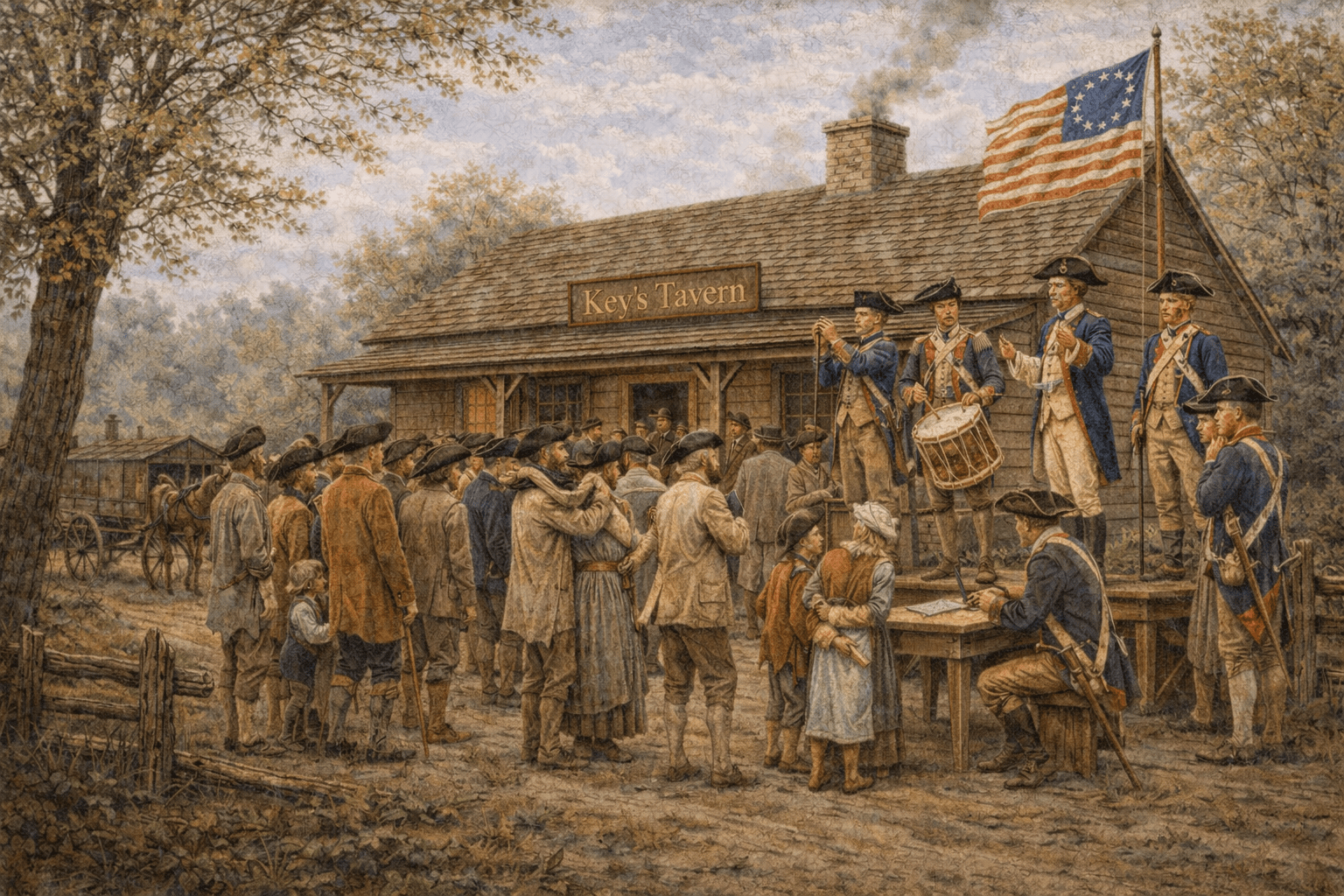
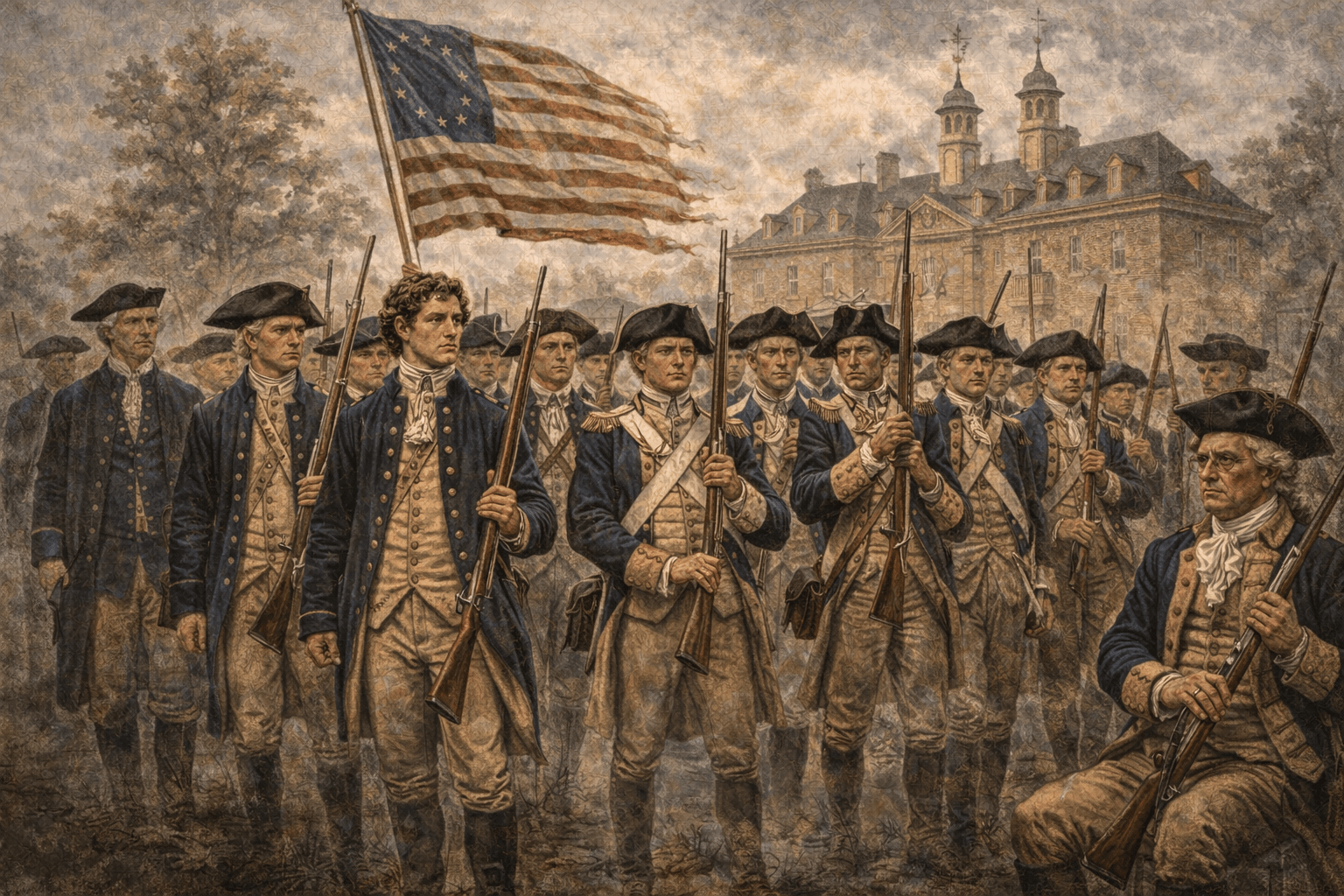
- Governor Thomas Jefferson on December 4, 1779 authorizes the formation of a student artillery company—often called the William & Mary College Company—composed of students, faculty, and local volunteers.

December 1
Charleston Disaster
- The war moves south as Britain changes its war strategy and focuses on the Southern colonies. The Continental Army marches south to meet this new threat. British forces under Henry Clinton and Charles Cornwallis surround Charleston by land and sea, cutting off all supplies and escape routes.
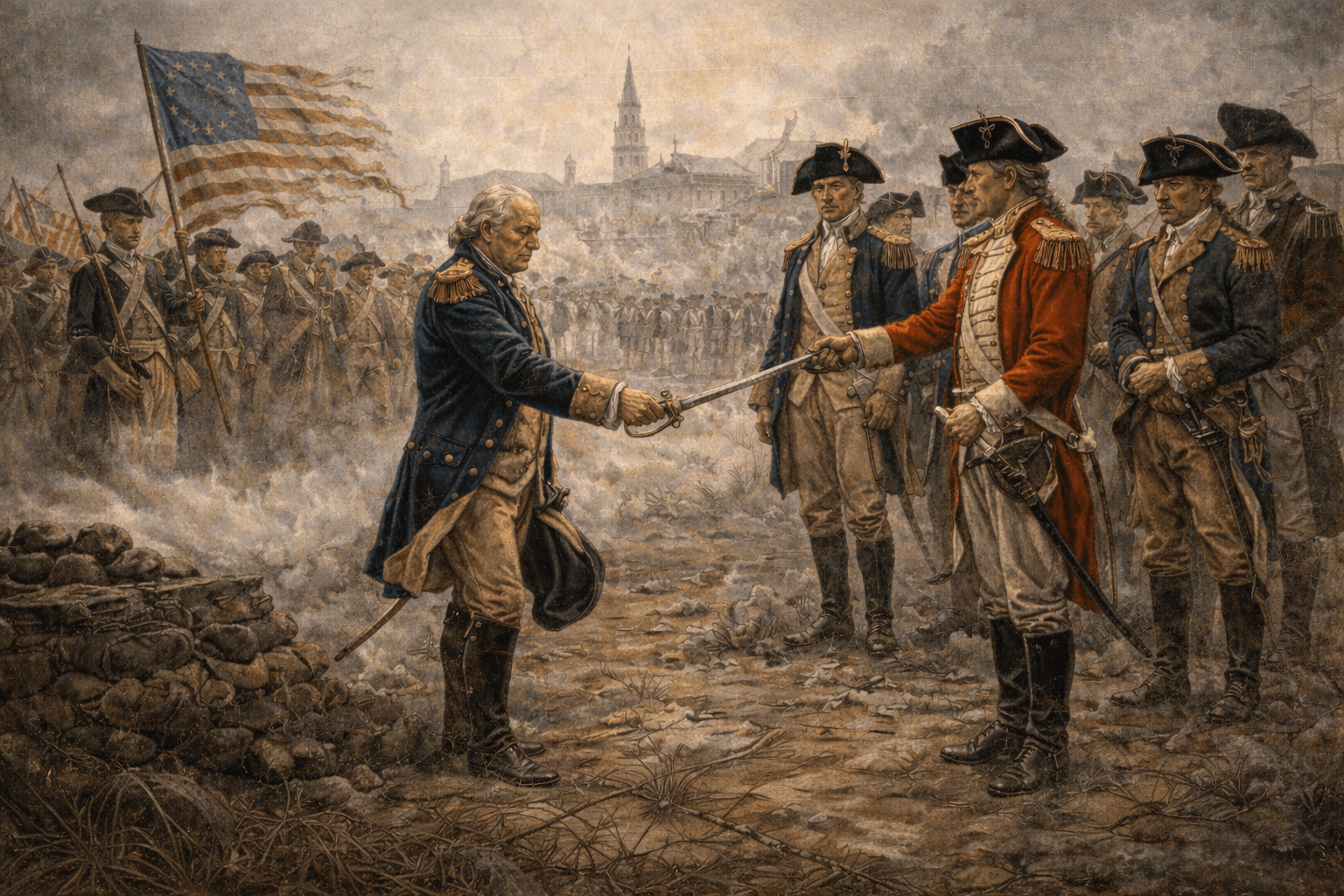
- After weeks of bombardment and failed breakout attempts, American commander Benjamin Lincoln surrenders Charleston on May 12, 1780. About 5,400 American soldiers are taken prisoner—including Samuel Jordan Cabell and Benjamin Taliaferro—making it the largest single capture of American forces during the entire war.
1780
1781
February 1
Militia Strain
- On 23 Feb 1781, William Cabell provides Capt. Young Landrum with two well-fitted smoothbore guns for his militia.
- Four days later, William Cabell spots Capt. Landrum and his militia of about 80 men marching South past Union Hill to join Nathanael Greene near the mouth of the Tye River. He hears the remainder of the lower battalion was sent more than 50 miles out of the way to Harper’s Ferry and Moore’s Ordinary in Prince Edward County to rendezvous.

- William Cabell records his frustration in his diary, writing, “Strange orders and conduct when the enemy are almost at our doors.”
1782
March 1
Aftermath
- The surrender largely ends major fighting. News reaches Britain in late 1781, further weakening political support for continuing the war, and contributes to the collapse of Frederick North, Lord North’s government in March 1782.
- Many rank-and-file prisoners captured at Charleston remained in captivity or under restrictive parole until exchanges accelerated in early 1782.
- April 1783: Amherst County resident Benjamin Taliaferro—who took command of the Amherst Riflemen after Samuel Jordan Cabell’s promotion—was finally released from prison in Charleston.

1783
September 3
The United States Independence Formally Recognized
- The Treaty of Paris (1783) was signed on September 3, 1783, in Paris formally ending the Revolutionary War
- Britain acknowledged the United States as “free, sovereign and independent.”

1788
Works Consulted
- Brown, Alexander. The Cabells and their Kin: A Memorial Volume of History, Biography, and Genealogy. Richmond, Va.: Garrett and Massie, Inc., 1939. First published 1895.
- Cabell Family Papers, 1727-1875, Accession # 5084, Albert H. and Shirley Small Special Collections Library, University of Virginia, Charlottesville, Va.
- Cabell, William, Sr. Commonplace Books, 1769–1795. MSS5:5 C1117:1–9. Manuscripts Collection. Virginia Museum of History and Culture, Richmond, VA.
- Jefferson, Thomas. “Diary of Arnold’s Invasion and Notes on Subsequent Events in 1781: Versions of 1796?, 1805, and 1816.” Founders Online. National Archives. Accessed February 14, 2026. https://founders.archives.gov/documents/Jefferson/01-04-02-0323-0002
- Nance, Joanne Lovelace. “Revolutionary War Minute Men.” Magazine of Virginia Genealogy 31, no. 4 (November 1993).
- Seaman, Catherine Hawes Coleman. Tuckahoe and Cohee: The Settlers and Cultures of Amherst and Nelson Counties, 1607–1807. Sweet Briar, VA: Sweet Briar College Printing Press, 1992.
- Sweeny, Lenora Higginbotham. Amherst County, Virginia in the Revolution: Including Extracts from the “Lost Order Book” 1773–1782. Lynchburg, VA: J. P. Bell Company, 1951.
- Swem, E. G., and John William Williams, comps. A Register of the General Assembly of Virginia, 1776-1918, and of the Constitutional Conventions. Richmond: D. Bottom, Superintendent of Public Printing, 1918. Digital image. Internet Archive. https://archive.org/details/registerofgenera00virg/.
- Virginia. General Assembly. A Register of the General Assembly of Virginia, 1776–1918, and of the Constitutional Conventions. Compiled by E. G. (Earl Gregg) Swem and John William Williams. Richmond: D. Bottom, Superintendent of Public Printing, 1918. Digital Archive. Internet Archive.
- Virginia. General Assembly. House of Delegates. Journal of the House of Delegates of the Commonwealth of Virginia. Richmond: Commonwealth of Virginia, 1776. Internet Archive.
- Virginia. General Assembly. House of Delegates. Journal of the House of Delegates of the Commonwealth of Virginia, 1777–1780. Richmond: Commonwealth of Virginia, 1780. Internet Archive.
- Virginia. General Assembly. House of Delegates. Journal of the House of Delegates of the Commonwealth of Virginia, 1781–1786. Richmond: Commonwealth of Virginia, 1786. Internet Archive